
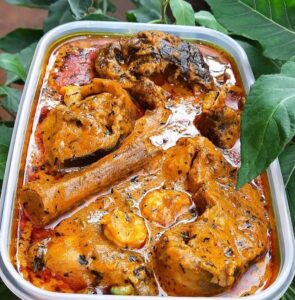
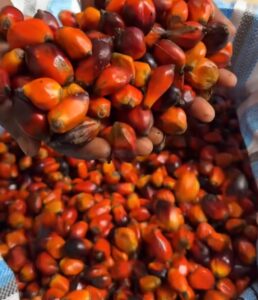
You know that feeling when you taste something so good you want to slap your grandmother? (Please don’t actually do that. That’s banga soup for you. This thick, aromatic, palm nut-based delicacy has been making people lose their composure in the Niger Delta region for centuries, and it’s finally getting the global recognition it deserves. The history of banga soup is as rich and complex as the soup itself, filled with sacred traditions, ancient taboos, and cultural drama that stretches back generations.
In fact, CNN Travel featured banga soup as the very first entry in their list of “20 of the World’s Best Soups,” describing it as the perfect start to a “world tour of the tastiest soups.” Not bad for a dish that comes with more rules, taboos, and cultural drama than a royal coronation.
But the history of banga soup goes far deeper than international acclaim. Here’s something wild that CNN didn’t mention: you could literally get cursed for using the wrong firewood to cook this soup.
I’m not joking. There’s a documented case of an Urhobo woman who fell mysteriously ill with itchy rashes all over her body. Doctors couldn’t figure it out. Medications didn’t work. You know what the problem was? She’d unknowingly used firewood that had been used to roast tortoise meat. And in her community of Uvwiama, tortoises are sacred. It took a trip back to her village, a meeting with the chief priest, and traditional sacrifices to cure her.
Welcome to the fascinating, complex, and absolutely riveting world of banga soup (Amiedi), where food isn’t just food. It’s identity, history, spirituality, and a whole lot of drama.
What Is Banga Soup (And Why Should You Care)?
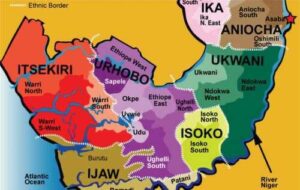
Before diving deeper into the history of banga soup, let’s establish what we’re talking about. Banga soup, known as Amiedi among the Urhobo people and Izuwo ibiedi among the Isoko, is a rich, aromatic soup made from palm fruits. But calling it “just soup” is like calling the Mona Lisa “just a painting.” This dish is the cultural heartbeat of the Urhobo and Isoko people of Delta State in Nigeria’s Niger Delta region.
The soup combines palm fruit extract with scent leaves or bitter leaf, pepper, crayfish, special flavors called beletete or rohojie, onions, salt, and assorted meat or fish (fresh, dried, or smoked). Every single ingredient can be sourced locally, which is partly why this soup has survived for centuries.
But here’s where it gets interesting: the Urhobo and Isoko people were considered one group until 1950 when they separated politically. Even now, decades later, they share this culinary tradition like siblings sharing childhood memories.
CNN’s Love Letter to Banga Soup
When CNN Travel compiled their list of the world’s best soups, they didn’t just include banga soup. They led with it. “We’ll start our world tour of the tastiest soups with banga,” they declared, giving this Niger Delta delicacy prime position among global favorites like Vietnamese pho, French bouillabaisse, and Ukrainian borscht.
CNN highlighted what makes it special: “Fruits from the oil palm tree lend both fat and flavor to this soup from the Niger Delta, which also features fresh catfish, beef and dried seafood.” They noted that banga is so beloved in Nigeria that ready-mixed banga spice packets are sold in shops nationwide, a testament to its widespread popularity.
The recognition sent ripples through Nigerian communities worldwide. Finally, the international media was acknowledging what Nigerians have known for centuries: this soup is extraordinary. But what CNN’s brief feature couldn’t capture is the intricate web of cultural traditions, sacred taboos, and community rules that make banga soup not just delicious, but deeply meaningful.
The Many Faces of Palm Nut Soup: A West African Phenomenon
Here’s what makes the history of banga soup truly fascinating: it’s not just an Urhobo and Isoko thing. This soup has cousins all over Nigeria and West Africa, each with its own personality, preparation style, and cultural significance. Understanding the history of banga soup means recognizing its place in the broader palm nut soup tradition across the continent.
The Igbo Version: Ofe Akwu
The Igbo people of southeastern Nigeria have their own beloved variant called ofe akwu (literally “palm nut stew”). While it shares the same base ingredient, palm fruit extract but the similarities end there.
Ofe akwu is typically lighter and is primarily served with white rice, not the starch that Delta people prefer. The Igbo version uses scent leaves (nchuanwu) or a combination of scent leaves and ugu (pumpkin leaves), but rarely bitter leaves. They often add ogiri okpei (fermented locust bean) for that deep, umami flavor.
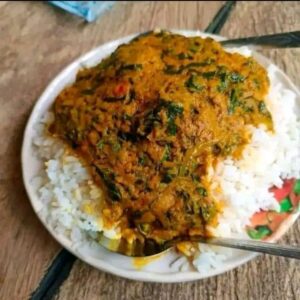
In Nnewi (a major Igbo town), ofe akwu is so sacred that it’s mandatory at every major celebration. Fail to serve ofe akwu to the umu ada (daughters of the community) at a ceremony? That’s a fineable offense. The soup is typically paired with white rice for the women, while ofe onugbu (bitter leaf soup) goes with fufu or pounded yam.
The Igbo also make a distinction between the stew variety (eaten with rice) and using palm fruit extract to prepare other soups like oha and onugbu, which are eaten with “swallow” foods like akpu (pounded cassava).
The Yoruba Take: Obe Eyin
Move westward to Yorubaland, and you’ll find obe eyin; the Yoruba interpretation of palm nut soup. “Eyin” (with the right tonal inflection) means palm nut in Yoruba, though be careful with pronunciation because the same word can also mean “egg” with a different tone!
Obe eyin is prepared similarly to banga but often includes more tomato and can incorporate okra for thickness. Yorubas typically eat it with various swallows like eba, fufu, pounded yam, or even boiled rice and yam. Some families prepare iresi eyin; a Yoruba-style jollof rice made with palm nut cream, which is the Yoruba equivalent of the Urhobo banga rice.
The Edo/Bini Connection
The Edo people (including the Bini and Esan ethnic groups) have fascinating palm-based soups. While they have a version similar to ofe akwu in preparation, the Esan people are particularly famous for their black soup (omoebe or omebe) which sometimes uses banga (palm fruit extract) as its base instead of palm oil.
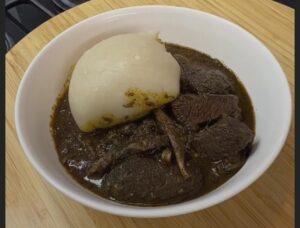
The black soup gets its distinctive dark color from stone-ground vegetables and that is particularly bitter leaf, scent leaf (efinrin), and uziza leaf; mixed with the palm fruit base. It’s so beloved that Bini people, who initially mocked the Esan for eating this soup, have now fully embraced it, especially after seeing its presentation at Esan weddings and learning about its medicinal properties.
The Ghanaian Classic: Abenkwan
Cross the border into Ghana, and palm nut soup is called abenkwan (in Akan language). It’s also known as palmnut soup or abe nkwan, depending on which Ghanaian region you’re in.
Ghanaian abenkwan often includes ingredients like prekese (Aidan fruit) for its aromatic, umami flavor. They use kontomire leaves (a type of spinach) or other leafy greens. The soup is typically served with fufu, omo tuo (rice balls), banku (fermented corn and cassava dough), or fonio (an African heritage grain).
The Ghanaian version is a communal dish, deeply tied to family gatherings and celebrations. Making abenkwan is considered a skill passed down through generations, with grandmothers teaching granddaughters the proper way to extract palm nut cream and balance the flavors.
The Cameroonian Variant: Mbanga Soup
In Cameroon, the palm fruit soup is called mbanga and is traditionally made with fresh palm nuts (though canned versions are used in the diaspora). Mbanga is often served with kwacoco and includes smoked fish and njangsa seeds (African nutmeg) for a distinctive flavor profile.
The soup represents Cameroon’s contribution to the broader West African palm nut soup tradition, with its own unique spice combinations and serving traditions.
What Unites Them All
Despite the regional differences, all these soups share common DNA:
– Palm fruit as the foundational ingredient
– Rich, protein-heavy preparations with fish and/or meat
– Deep cultural and ceremonial significance
– Preparation methods passed down through generations
– The use of local leaves and spices to distinguish regional identity
The beautiful irony? While each group claims authenticity and superiority for their version (remember the Urhobo-Itsekiri soup wars?), they’re all part of one magnificent culinary family tree. The palm nut soup tradition stretches across West and Central Africa, binding communities through shared ingredients while allowing each culture to stamp its unique identity on the final dish.
The Mystery of Origins: Where Did Banga Soup Actually Come From?
Here’s where I need to be honest with you: the history of banga soup is shrouded in mystery because nobody knows exactly when or how it was invented. And that’s not because researchers haven’t tried to find out but because the origins are so ancient that they predate written records.
The Urhobo and Isoko people have been making Amiedi soup for centuries, possibly millennia. We’re talking pre-colonial times, back when the biggest concerns weren’t oil exploration but successful harvests and community survival. Our ancestors were too busy perfecting the soup and passing down techniques to their children to stop and write “Banga Soup: An Origin Story.”
What we can reasonably piece together:
The Niger Delta region has always been blessed (or cursed, depending on who you ask) with an abundance of palm trees. The oil palm (Elaeis guineensis) is indigenous to West Africa and has been a cornerstone of life in this region since time immemorial.
Initially, communities were extracting palm oil from the fruits and this much we know. Palm oil was used for cooking, lighting lamps, medicinal purposes, and trade. But at some point, someone looked at those palm nuts (the hard kernel inside the palm fruit) and had a brilliant realization: “What if we could extract something delicious from these too?”
That moment of innovation – whenever it happened – changed everything.
The process would have been discovered gradually. Perhaps someone boiled the palm fruits to extract oil more efficiently and noticed the flavorful liquid that resulted. Perhaps during lean times, people experimented with every part of the palm fruit to avoid waste. Or just maybe it was a happy accident in someone’s kitchen centuries ago.
What we know for certain is that the technique of boiling palm nuts, pounding them to release the cream, straining the mixture multiple times, and cooking it with local spices and proteins became deeply embedded in Urhobo and Isoko culture long before anyone thought to document it.
Why the Urhobo and Isoko are considered the originators:
The research is clear on one thing: the Urhobo and Isoko people have the most elaborate, deeply rooted cultural traditions surrounding banga soup. The taboos, the proverbs, the myths, the seasonal embargoes, the festival connections; all of these point to a soup that isn’t just food but a fundamental part of cultural identity.
When food becomes this interwoven with spirituality, community structure, and ethnic identity, it signals centuries (if not millennia) of tradition. You don’t develop complex food taboos tied to war legends and deity worship around a dish you borrowed from your neighbors 50 years ago.
The fact that both Urhobo and Isoko people were considered one group until 1950 and both share identical reverence for this soup (even calling it by related names which are Amiedi and Izuwo ibiedi) suggests the soup predates their political separation by a very long time.
The spread across West Africa:
As palm trees grew abundantly across the entire West African region, it makes sense that different communities independently discovered or learned from each other; how to make palm nut soup. The Igbo, Edo, Yoruba, Ghanaians, and Cameroonians all developed their own versions, each adapting the basic technique to their local tastes, available ingredients, and cultural preferences.
Think of it like this: palm nut soup is West Africa’s equivalent of bread. Many cultures make bread, each with their own style, but the basic principle (grinding grain, adding water, applying heat) is universal because the raw materials are widely available and the end result is delicious.
What the lack of recorded history tells us:
The absence of a documented origin story is actually more powerful than having one. It means banga soup is so ancient, so fundamental to the culture, that it existed before people felt the need to explain it. It was simply always there, like the rivers, the palm trees, and the traditions that bound communities together.
This is food as heritage in its purest form has passed down not through cookbooks or written recipes, but through watching, learning, tasting, and perfecting. Grandmother to mother to daughter (and yes, sons too). Generation after generation, each adding their wisdom while preserving the core.
So when someone asks “who invented banga soup?”, the honest answer is: we don’t know, and that’s exactly as it should be. Some traditions are too ancient, too sacred, and too collectively owned to be attributed to any one person or even one specific moment in time.
What we do know is this: for as long as anyone can remember, the Urhobo and Isoko people have been the primary custodians of this culinary tradition, and their version; with all its taboos, proverbs, and cultural weight represents the deepest expression of what banga soup means beyond just sustenance.
The Matriarchs of Banga: Women as Keepers of Tradition
If you really want to understand the history of banga soup and who kept it alive through centuries, through colonialism, through modernization, and through cultural shifts; look to the women. The grandmothers, the mothers, the aunties who gathered in kitchens and courtyards, their arms strong from pounding, their knowledge deep from watching and learning.
In traditional Urhobo and Isoko households, banga soup preparation was primarily women’s domain. Not because men couldn’t cook (they could), but because the preparation of this soup was so intricately tied to community, family bonds, and the transmission of cultural knowledge that it became a sacred trust passed from one generation of women to the next.
The Physical Labor: More Than Just Cooking
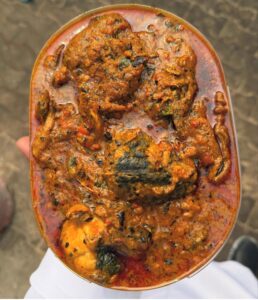
Let’s talk about what these women actually did, because “making banga soup” doesn’t capture the half of it.
Before blenders, before food processors, before any modern convenience, our grandmothers and great-grandmothers were doing this: They’d collect palm fruits – sometimes walking considerable distances to find the best ones. They’d build fires. They’d boil the palm nuts for hours until the outer flesh softened. Then came the real work.
Using large mortars (sometimes carved from tree trunks) and heavy pestles, they’d pound these boiled palm nuts. Pound, pound, pound. For hours. The rhythmic sound of pestle meeting mortar was the soundtrack of preparation. This wasn’t just cooking – it was a full-body workout that built the kind of arm strength that became legendary.
After pounding, they’d transfer the mashed palm fruit pulp to large bowls, add hot water, and begin the extraction process. Using their hands (protected by heat-resistant experience), they’d squeeze and press the pulp repeatedly, extracting every bit of the rich, reddish-orange cream. Then they’d strain it. And strain it again. And often, strain it a third time to get that perfect consistency.
All of this before the actual cooking even began.
No wonder our grandmothers had such strong biceps. No wonder the younger women watched in awe. This wasn’t just meal prep – it was an act of love, endurance, and cultural preservation that demanded respect.
The Gathering: Where Knowledge Was Transferred
In traditional settings, banga soup preparation was often a communal affair. Elderly women would gather – sometimes at someone’s compound, sometimes in preparation for a major ceremony or celebration. The younger women and girls would join them, not just to help, but to learn.
This is where the real magic happened. This is where cultural knowledge was encoded and transmitted.
As they worked, the elderly women would share:
– Which palm fruits were best for soup versus oil
– How to tell when the nuts were boiled enough
– The exact consistency the cream should have
– Which combinations of meat and fish worked best
– The secret spice blends that made their family’s version special
– The stories behind the taboos (never use tortoise from Uvwiama, never use dog meat for Orogun people)
– The proverbs that carried wisdom (“having a basket is not a license to collect palm fruit”)
– The seasonal knowledge (when to harvest, when embargoes were in place)
These weren’t formal cooking lessons. This was oral history, cultural preservation, and family bonding all wrapped into one labor-intensive culinary experience. The soup was the medium; the lesson was life itself.
Women as Cultural Gatekeepers
Women didn’t just make the soup, they enforced the traditions and taboos that kept it culturally significant.
When a daughter was getting married and moving to her husband’s community, her mother would ensure she knew not just how to make banga soup, but how to make it correctly for her new community. Which meats to avoid. Which spices her husband’s people preferred. The balance and proportions that would mark her as someone who understood tradition.
When guests visited from other clans, it was the women who had to know: Where are they from? What are their taboos? Can I serve them this version, or do I need to prepare something different?
It was the women who remembered that the Ozoro woman visiting doesn’t eat snail. That the Orogun family never touches dog meat. That the Uvwiama elder would be offended by anything connected to tortoise. This knowledge – memorized, catalogued, and carefully applied – was the difference between hospitality and insult, between honor and shame.
The Spiritual Dimension
Remember that female traditional doctor in Ozoro who used snails as sacrifice to the gods (Odimodi) to protect her people during wartime? That’s not just a random detail. It shows that women held spiritual authority connected to food, to protection, to the very survival of their communities.
In many Niger Delta communities, certain foods and their preparation carried spiritual weight. Women, as the primary preparers, became the intermediaries between the physical act of cooking and the spiritual significance of the meal. They knew the prayers, the rituals, the proper way to handle ingredients that connected to deities and ancestral spirits.
When women prepared banga soup for major ceremonies – naming ceremonies, marriages, funerals, festivals – they weren’t just feeding people. They were performing a cultural and spiritual service that linked the present generation to ancestors and traditions stretching back centuries.
The Modern Transition: What’s Being Lost and Saved
Today, things are different. Blenders have replaced mortars. Canned palm fruit extract sits on store shelves. Young women in the diaspora watch YouTube tutorials instead of learning at their grandmother’s side.
Some knowledge is being lost. The muscle memory of the perfect pounding rhythm. The instinct for when the cream extraction is complete. The subtle distinctions between palm fruit varieties that only come from years of hands-on experience.
But here’s what’s beautiful: the women are still keeping the tradition alive, just in new ways.
Mothers are teaching daughters via video calls across continents. Grandmothers are writing down (finally!) the recipes that were only ever in their heads. Women’s groups in the diaspora are gathering to make banga soup together, recreating those communal preparation sessions in London kitchens and Toronto basements.
Food bloggers (many of them women) are documenting the traditions, the taboos, the cultural significance. The knowledge isn’t disappearing – it’s being preserved in new formats for new generations.
The Unsung Heroes
When we eat banga soup today – whether in a Lagos restaurant, at a family gathering in Delta State, or in a Nigerian household in Houston – we’re tasting the labor of countless women whose names we’ll never know.
The women who woke up early to start the fire spent hours pounding in the heat. They strained the cream until their arms ached and memorized every taboo and recipe variation. These matriarchs passed the knowledge to their daughters even when those daughters seemed uninterested, and adapted traditional methods to modern kitchens while keeping the essence intact..
These women are the true custodians of banga soup and the reason this tradition survived colonialism, modernization, migration, and time itself. The matriarchs of banga deserve celebration, not just passing mention
So the next time you enjoy a perfectly balanced bowl of banga soup, remember: you’re not just tasting palm fruit and spices. You’re tasting generations of women’s wisdom, labor, love, and determination to keep their culture alive, one pot at a time.
The Proverb That Changes Everything
There’s an Urhobo proverb that perfectly captures the essence of banga soup culture: “Having a basket is not a license to collect palm fruit” (odiẹ a da mrẹ obere ke kpẹ okọ ọọ).
In other words, just because you have the tools doesn’t mean you have the knowledge, the right, or the permission to make this soup. Banga soup preparation is a technical and sophisticated culinary activity that demands deep knowledge of local tradition and custom. Miss a step, break a taboo, and you’re not just making bad soup – you could be inviting spiritual consequences.
This isn’t superstition. This is cultural preservation coded in culinary rules.
The Royal Treatment: Banga Soup in Traditional Courts
Here’s something that elevates banga soup from everyday comfort food to prestigious delicacy: it wasn’t just peasant food (not that there’s anything wrong with that). Banga soup was served in royal courts across the Niger Delta kingdoms.
When the Olu of Warri wanted to impress visitors and dignitaries, you can bet banga soup made a grand appearance at the feast. The preparation of banga soup for royalty was taken seriously – we’re talking about a culinary production worthy of kings.
Special ingredients were meticulously selected: the freshest catfish from the rivers, premium cuts of meat, the finest dried fish, and top-quality crayfish. The scent leaves had to be just right, the palm fruit extract had to be from the best local species, and the person cooking it better know exactly what they were doing or risk royal side-eye (or worse).
In royal contexts, banga soup represented more than sustenance. It was a statement of cultural pride, a display of the region’s natural abundance, and a demonstration of culinary mastery. The soup served to royalty had to achieve the perfect balance – neither too thick nor too watery, with ingredients in harmonious proportion, and flavors that sang together rather than competed.
This royal connection gave banga soup a prestige that persists today. When prepared correctly, with attention to traditional methods and quality ingredients, banga soup isn’t just food – it’s a dish fit for kings.
The Seasonal Drama: When Banga Season Ends, Change Soup
Palm trees in Urhobo and Isoko areas produce fruits abundantly from November to early May. During this glorious season, you have your pick of the best local palm fruits (elaeis guineensis) – the ones low in cholesterol and rich in heart-friendly nutrients.
But from late May to late October? Good luck finding quality fruit. The rainy season makes palm fruits scarce, especially the prized local variety. This scarcity birthed another famous proverb: “When there is no banga (palm fruit), change soup” (a be mrẹ edi, gbe wene owho).
It’s practical wisdom wrapped in humor. Can’t find the ingredient? Make something else. Don’t force it.
But the scarcity isn’t just about weather. Cultural festivals also create embargoes on harvesting. During the Efa festival celebrated by the Ovu people every February, palm fruit harvesting stops completely until early March. This allows the community to focus on celebration while giving the palm trees a break to produce mature fruits.
In Ozoro (Isoko area), there’s a similar embargo from early November to late December to prevent people from harvesting unripe fruits out of economic desperation. The wisdom here is profound: patience yields better quality.
The Biotech Problem Nobody Talks About
Here’s a modern twist: not all palm fruits are created equal anymore.
Traditional banga soup uses fruits from local species (elaeis guineensis). But population growth and mechanized farming have introduced biotechnologically engineered varieties like Tenera, Dura, and Psifera. These are great for oil and kernel production, but terrible for authentic banga soup.
Why? They’re extremely high in cholesterol and fat. When you use them for soup, the liquid becomes unnaturally thick and heavy. The delicate balance that makes banga soup special gets completely thrown off.
So now, making authentic banga soup means navigating a marketplace full of biotech palm fruits to find the increasingly rare local varieties. It’s like trying to find organic heirloom tomatoes in a supermarket full of genetically modified produce. Possible, but requires knowledge and effort.
The Sacred Taboos: When Food Becomes Spiritual Warfare
This is where banga soup’s history gets truly fascinating. The Urhobo and Isako people have complex food taboos (Egha) tied to specific meats and ingredients. These aren’t random preferences but they’re rooted in myths, legends, and historical events that define community identity.
The Snail Sanctuary of Ozoro
In the Isoko communities of Ozoro, Olomoro, and Irri, eating snails is absolutely forbidden. According to myth, during a war, a female traditional doctor used snails as sacrifice to the gods (Odimodi) to protect the people from enemies. The sacrifice worked. The community was saved.
Now, snails are sacred protectors. Despite being rich in collagen and protein which are suppose to be perfect for banga soup, sadly are off-limits. If you’re cooking for someone from Ozoro, keep the snails out. Period.
The Dog That Saved Orogun
In Orogun (Urhobo), eating dog meat is taboo. The legend tells of bush dogs that led trapped warriors to safety during inter-tribal warfare. The dogs became tied to a deity and are now worshipped. All dogs wild and domesticated are protected.
Same community also forbids iguana meat. So if you’re preparing banga soup for Orogun people, scratch those proteins off your list.
The Tortoise Mothers of Uvwiama
Remember that woman with the cursed firewood? Her community, Uvwiama, reveres tortoises as “mothers.”
The legend is cinematic: during an inter-tribal war, Uvwiama soldiers were trapped between a river and their enemies. No hope. No escape. Then a giant tortoise appeared, ferrying the surrounded warriors to safety across the river, trip after trip.
The community built shrines. Erected altars. Decreed that no tortoise shall ever be killed or eaten by any son or daughter of Uvwiama. The tortoise became more than food, it became sacred family.
This is why that woman got sick from tortoise-roasted firewood. Even indirect contact with the taboo brought spiritual consequences.
One Man’s Meal Is Another Man’s Poison
Here’s what makes this even more interesting: these taboos are geographically specific.
Dog meat in banga soup? The people of Ovu in Ethiope East will happily enjoy that delicacy. They have no taboo against it. But serve the exact same soup to someone from Orogun, and you’ve just served them poison, not physically, but spiritually and culturally.
The saying goes: when a prohibitive element is added to banga soup without the eater’s knowledge, they will suffer the consequences of that broken taboo. Even if they didn’t know. Even if they had no ill intent.
This creates a fascinating culinary minefield. Restaurant owners preparing banga soup for diverse customers have to know their clientele’s origins. Special versions get prepared for specific communities. One pot doesn’t feed all.
When an Urhobo or Isoko person is served banga soup that violates their community’s rules, they react with the phrase: “Ọba gha idu” (The Oba forbids cocoyam). Translation: “This is inconceivable. I cannot eat this.”
The Great Itsekiri Soup Wars
If you think the taboos are dramatic, wait till you hear about the ethnic soup rivalry between the Urhobo and Itsekiri people. Both groups make banga soup. Both claim authenticity. Neither accepts the other’s version. The beef (pun intended) is real. The Urhobo have two specific complaints about Itsekiri banga soup:
Problem 1: “O faro kufia kerẹ Amiedi rẹ Irobo”* (It looks spectacularly worthless like the Itsekiri Amiedi soup)
According to Urhobo elders, Itsekiri banga soup “glitters with ingredients but is tasteless.” It’s all show, no substance. Like someone who dresses gorgeously but has no inner virtue. The saying has evolved beyond food to become a general insult.
Problem 2: “Ugborekokomiyo”* (A forest of ingredients)
This is the more serious accusation. Urhobo and Isoko people believe in balance, the right proportion of palm fruit liquid to condiments. There must be enough soup to dip your eba, fufu, or starch. But the Itsekiri version? It’s so packed with meat, fish, periwinkles, snails, crayfish, crabs, spices, and vegetables that it becomes one giant solid mass. The earthen pot (evwẹrẹ) is filled to the brim. You can’t see the bottom without eating through a mountain of ingredients.
The Urhobo find this suspicious. Like, “what are you hiding at the bottom of that pot?” The abundance creates distrust instead of generosity. The Itsekiri have their own name for this style: “egbelekokomiyo” which mean “the fowl does not reject corn.” Their description? “A combination of love, character, good food and sex.” So while the Itsekiri see their loaded soup as abundance and affection, the Urhobo see it as potentially dangerous concealment. Cultural perspectives, right?
The Health Benefits Hidden in Tradition
Let me pause the drama to give you some science: banga soup is actually incredibly nutritious.
The palm nut extract is rich in heart-friendly fats, low in saturated fat, and cholesterol-free (when using the local species). It contains potassium and vitamin E. Add the protein from fish and meat, the vitamins from scent leaves or bitter leaves, and you’ve got a balanced meal that sustained communities for centuries before anyone knew what “macronutrients” were.
Our ancestors weren’t nutritionists, but they were onto something. The combination of fat from palm fruit and protein from fish/meat creates satiety and energy. The vegetables add micronutrients. The spices aid digestion. Traditional wisdom often contains scientific truth we’re only now beginning to understand.
The Colonial Period: When Banga Stayed True
When British colonizers arrived in the Niger Delta, they encountered banga soup. Some adapted. Many didn’t. But here’s the beautiful part: banga soup didn’t change for them.
While other aspects of culture bent under colonial pressure, this soup remained defiantly itself. It was resistance in a pot. Cultural preservation served daily. Every family gathering around banga soup was an act of maintaining identity against foreign influence.
The soup survived colonialism, survived political separation of Urhobo and Isoko, survived modernization, and is now making its way to international tables. But it hasn’t been diluted. The taboos remain. The traditions persist. The proverbs still guide preparation.
Modern Banga: Going Global While Staying Rooted
Today, you can find banga soup in London, Houston, Toronto, and anywhere the Nigerian diaspora has settled. Canned palm fruit extract sits on African store shelves. Blenders have replaced mortars (though purists say it’s not the same).
The internationalization of banga soup has made it accessible. But here’s what hasn’t changed: the cultural constraints and taboos still apply. A second-generation Nigerian in Canada might not know all the rules, but their parents do. The knowledge gets passed down, adapted but not abandoned.
Restaurants catering to Nigerian communities still prepare special versions for customers from different clans. The question “where are you from?” before cooking isn’t small talk, it’s necessary intelligence.
Ready to Make Your Own Banga Soup?
Now that you know the rich history of banga soup, cultural significance, and sacred traditions behind this iconic soup, you might be wondering: how do I actually make it? Authentic banga soup recipe. Whether you’re cooking for the first time or you’re a seasoned pro looking to perfect your technique, understanding the history of banga soup makes every pot of the soup taste even better. Just remember to respect the traditions, know your audience, and never use tortoise meat if you’re cooking for someone from Uvwiama!
What This All Means: Food as Cultural Encryption
The history of banga soup teaches us something profound: food is never just food.
It’s identity encoded in ingredients. History preserved in recipes. Spirituality expressed through taboos. Resistance performed through persistence. Community boundaries drawn with condiments. Every bowl of banga soup that makes it to a table has navigated seasonal availability, cultural prohibitions, community-specific taboos, ethnic rivalries, quality ingredient sourcing, and centuries of accumulated knowledge.
The soup is a living archive. The taboos are cultural encryption. The proverbs are wisdom databases. The preparation is ritual. The consumption is communion with ancestors and affirmation of identity. When the Urhobo say “you don’t collect palm fruits because you have a basket,” they’re saying: tools without knowledge are useless. Access without understanding is dangerous. Participation without respect is violation.
The Last Word
So the next time you encounter banga soup, remember: you’re not just tasting palm fruit and spices. You’re encountering centuries of history, complex social structures, spiritual beliefs, ethnic relations, environmental wisdom, and cultural resistance.
That bowl represents survival of tradition in a globalizing world. It represents the delicate balance between change and preservation. It represents identity that refuses to be diluted.
And yeah, it’s also absolutely delicious when made right. Just make sure you know whose grandmother’s recipe you’re following, what meat you’re using, and who you’re serving it to.
Because in the world of banga soup, ignorance isn’t bliss. It might just be cursed firewood.
Have you experienced banga soup culture? Know any other food taboos tied to Nigerian communities? Share your stories in the comments and let’s keep this cultural knowledge alive!