
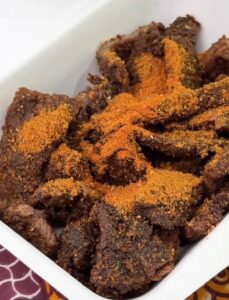
If you have ever stood by a roadside in Nigeria as night falls, you will recognise the scene. Your eyes drawn to the glow of hot coals. And your nose catching that unmistakable smoky, spicy aroma in the air. Then you understand this clearly, Suya is not just food but a feeling, memory and Nigeria on a stick. The history of suya reflects more than the story of grilled meat; it tells the story of culture, tradition, trade, and the vibrant street food heritage of Nigeria.
However, suya did not begin at a street corner in Lagos or Abuja. Its story stretches back centuries, across desert trade routes and pastoral grasslands. Nomadic peoples carried it with them, cooking over open fires long before any city existed to sell it in. Today, we will trace that journey from the campfire to the grill stand. We will follow it from Northern Nigeria to London and beyond.
Pull up a seat. This is the history of suya.
What Is Suya? A Look at the History of Suya
Suya is a West African spiced, skewered, and charcoal-grilled meat dish that originated with the Hausa people of northern Nigeria. It is made from thinly sliced beef (or chicken, ram, or offal). Then coated in a dry spice blend called yaji, and grilled over hot coals. Vendors often serve it with sliced onions, tomatoes, and extra yaji on the side.
In terms of taste: think smoky, nutty, fiery, deeply savoury, and completely addictive. There is nothing else quite like it.
Similar dishes exist across West Africa under different names. Ghanaians call it chichinga, Gambians call it afra, Senegalese call it dibi, and Cameroonians call it soya. But the version most widely known internationally is Nigerian suya, and that is the story we are telling today. Understanding the history of suya helps explain why it is so deeply rooted in Nigerian culture.
Where Did Suya Come From? The History of Suya and its Origins
To understand suya, you first have to understand the people who created it. Long before suya had a name, it had a purpose, and that purpose was survival.
Historical evidence points to suya and its relatives originating with pastoral nomads. These include the Hausa and Fulani peoples of West and Central Africa. They ranged across what is now northern Nigeria, Cameroon, Niger, and parts of Sudan. These communities lived on the move. They travelled with herds of cattle, using every part of their livestock for food and trade. Researchers suggest early suya may have involved coating meat in ash. This helps dry the meat for preservation while keeping flies away (Earthworm Express, 2024).
Picture it. A group of nomadic herdsmen, somewhere in the West African savannah. They sit around a campfire at the end of a long day on the move. Meat skewered on bamboo sticks, rubbed with whatever spices and groundnut they had, slowly crisping over the flames. That, researchers believe, is where suya begins.
In the Hausa language, the word relates to the concept of cooking or frying over heat. Also, the Hausa people use the older name tsire, and many Hausa communities still use that term today. Even as the rest of Nigeria and the world knows it as suya. The history of suya cannot be separated from the movement of Hausa traders across West Africa.
The Hausa People on the History of Suya
It would be a mistake to see suya as a dish that developed in isolation. It emerged from the heart of one of West Africa’s great civilisations.
Between the 10th and 19th centuries, the Hausa city-states grew in power. These included Kano, Katsina, Zaria, and Daura. They developed from small agricultural settlements into powerful commercial and political hubs. Their wealth came from the Trans-Saharan trade routes. These were camel caravans routes across the Sahara Desert, linking West Africa with North Africa and beyond. The Hausa traded leather, cloth, gold, kola nuts, and salt and their language became widely spoken across West Africa.
It was along these same trade networks that Hausa food culture spread. This included the tradition of spiced, grilled meat. As Hausa traders and pastoralists moved, they brought their cooking methods and their spice knowledge with them. Food historians describe suya as a major Hausa contribution to world cuisine. This style involves grilling meat over charcoal and marinated in a dry spice rub. It is served simply with onions, tomatoes, and extra spice on the side (Vittles Magazine, 2020).
Ancient Islamic scholars called Mallams taught and advised communities across the Hausa states. Their title later became linked to suya sellers we know today. Nigerians widely call the mai suya, which means “seller of suya” in Hausa, a Mallam to this day. It is a quiet reminder of how deep this tradition runs.
Suya, Tsire, Kilishi, Balangu: The Three Forms of Hausa Grilled Meat
Here is something not everyone knows. What most Nigerians call suya is only one form of a wider tradition. It belongs to a family of Hausa grilled and preserved meat products. Food scientists and researchers classify suya into three main types (Igene and Mohammed, 1981; Ahmadu and Aduwa, 2015).
Tsire is the form most Nigerians knows best. It is fresh, skewered meat grilled over charcoal, spiced and sold at roadside stalls in the evening. It is the most popular by far, and when people say ‘suya’, this is almost always what they mean.
Kilishi is the dried version, suya’s shelf-stable cousin. Thinly sliced meat is dried in the sun, coated in a spiced groundnut paste, and then dried again. It has a much longer shelf life. In northern Nigeria, it is often sold as a travel snack or packaged gift.
Balangu is the slow-roasted version, where larger cuts of meat are used. These can include whole limbs, cooked low and slow over charcoal until tender and falling off the bone. It is less common than tsire but deeply loved in the north.
Each of these forms come from the same tradition. This includes cattle-rearing, spice knowledge, and open-fire cooking that the Hausa people developed over generations. Suya, in all its forms, is a complete culinary system.
What Is Yaji? The Suya Spice That Makes Everything
You can grill meat anywhere in the world. What makes suya unmistakably suya is the yaji.
Yaji is the spice blend, the soul of the dish. It is a complex, deeply aromatic dry rub. It combines ground peanut cake (kuli-kuli), dry hot chilli, cayenne peppers, ginger, dried onion, and salt. The mai suya presses the skewered meat into the mixture, adds vegetable oil, and grills it over charcoal. He serves extra yaji on the side for those who want more heat.
Kuli-kuli, roasted and pressed groundnut cake, is arguably what makes yaji uniquely West African. Groundnuts have been cultivated across the region for centuries. Their use in a dry meat rub represents a brilliant fusion of pastoral and agricultural traditions. The result is a flavour profile that is nutty, fiery, smoky, and deeply savoury all at once.
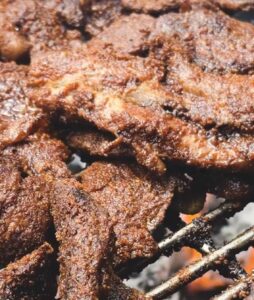
What is fascinating about yaji is how fiercely the Mallams protect its formula. As one Nigerian recipe authority puts it, the top Mallams of Hausaland guard the true yaji recipe as a closely kept secret. They pass this knowledge down through networks of northern Nigerian spice masters. Older brothers in the north often send it to relatives running grill stands in the south (All Nigerian Recipes). There is no single standard recipe. Ingredients vary by region and by individual cook. No two blends are exactly the same and is similar to curry blends in India.
Some regional yaji blends include dawadawa. Dawadawa is fermented African locust bean seeds. It adds a deep umami richness. Some blends also includes, negro pepper (uda), cloves, or turmeric. Yaji is not a recipe. It is a tradition.
The Mai Suya: Keeper of the Flame
The person at the grill is not just a food vendor. He is the custodian of a centuries-old art.
Hausa men called mai suya or mai tsire traditionally prepare suya and take the process very seriously. As Google Arts and Culture notes in its feature on suya, they treat it as both a skill and an art that requires learning. A good mai suya brings years of experience and expertise to every skewer he grills. The right thickness of the meat, right amount of yaji, and the distance from the coals is important. Timing matters too, that is knowing when to turn and when to add oil. All of this is craft knowledge, not just cooking.
Halal preparation methods are standard in the north, given that suya is deeply rooted in Hausa Muslim culture. The connection between suya and Islamic practice is very strong. And concerns about non-halal preparation have historically caused serious community tensions in parts of northern Nigeria.
While suya vendors are found across Nigeria today, women vendors are more common in the south. The original tradition of the Mallam at his grill stand remains the dominant image of suya culture. There is something almost theatrical about a skilled mai suya at work. He turns skewers slowly over the coals. The fire flares as the meat cooks. Spiced smoke fills the evening air.
How Suya Spread Across Nigeria: From the North to Every City
For a long time, suya was a northern Nigerian thing. The Hausa heartland, including Kano, Kaduna, Sokoto, and Maiduguri, was where it lived and thrived.
But urbanisation and internal migration through the 20th century changed everything. As Hausa traders and workers moved south for commerce, they brought their grill stands with them. Researchers studying suya production in Benin City (southern Nigeria) found that all producers were men from northern Nigeria. This shows how the trade followed the people who carried it (Ahmadu and Aduwa, 2015). The same pattern repeated itself across the south. In Lagos, Ibadan, Port Harcourt, Enugu, there was eventually a mai suya.
What happened next is one of Nigeria’s great food stories. Suya was adopted across ethnic and religious lines. A Yoruba family in Lagos, an Igbo trader in Onitsha, a civil servant in Abuja all eat suya. Few stop to think about its Hausa origins. It became affordable for everyone and available everywhere. Researchers and writers describe it as a unifying food in Nigeria. It crosses ethnic and religious divides (Ekanem, 1998).
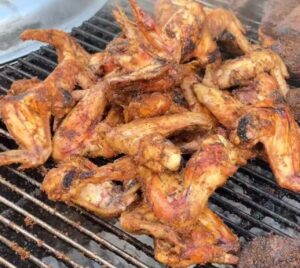
Today, suya has also evolved beyond its traditional beef base. You will find chicken suya, ram suya, gizzard suya, liver suya, kidney suya, and even prawn suya in Nigerian cities. The bones of the tradition remain the same; the table has just grown bigger.
The History of Suya Across West Africa
Nigeria is the heartland, but suya’s story belongs to the whole region. Wherever West African peoples have traded, migrated, or settled, versions of this dish have taken root.
Across the region, the dish goes by different names: afra in Gambia, chichinga in Ghana, dibi in Guinea-Bissau and Senegal. Each is a local evolution of the same fundamental tradition: spiced, skewered, grilled meat, shaped by local ingredients and palates. The spirit is identical.
This regional spread was not accidental. It followed the same pathways as the Hausa people. These included old trade routes across the region. It also followed seasonal movements of cattle herders. Merchants carried spices and livestock from one side of the continent to the other. Food travels with people.
Nigerian Suya in the UK, US, and the Diaspora
The 21st century has taken suya far beyond West Africa. Wherever Nigerians have settled, suya has followed.
In London, suya has been present since the 1990s. The city has a large diaspora community. Obalende Suya in Peckham became landmark for British Nigerians. Later came Alhaji Suya, the first Hausa-owned suya spot in London. Today, suya appears in Nigerian restaurants and Afrofusion menus. Writers noted that it has crossover appeal that no other Nigerian dish quite matches (Vittles Magazine, 2025).
In North America, Nigerian chefs are championing suya as part of a wider reclamation of African culinary heritage. Celebrity chef Kwame Onwuachi describeds suya as ‘the grandfather of American barbecue’. And is a bold claim. This highlights the link between West African grilling traditions and the barbecue. And these traditions has influenced food in the American South. They were carried partly through the culinary knowledge of enslaved West Africans.
For diaspora Nigerians everywhere, suya is more than food. It is home. A plate of suya can spark conversations about culture, history, and identity. For non-Nigerians, it is a warm, delicious entry point into understanding who Nigerians are.
Suya Food Safety: What the Research Says
Suya today stands at an interesting crossroads. On one hand, demand for suya has never been higher. This is true in Nigeria and across the world. Packaged suya spice is now a fast-growing food exports from Nigeria. On the other hand, researchers and public health experts have raised serious concerns about safety standards in suya production. They say the industry urgently needs improvement.
Multiple academic studies conducted across Nigeria report contamination in street sold suya. These studies were carried out in Benin City, Kano, Ogun State, Awka, Port Harcourt, and Calabar. They found evidence of microbial contamination in street-sold suya. These include bacteria such as Staphylococcus aureus, Salmonella species, E. coli, and Pseudomonas aeruginosa (Bello and Bello, 2020; Okhuebor and Izevbuwa, 2020; JENER, 2025). The causes are well known. These incude open-air preparation near busy roads. Old newspapers are sometimes used for packaging. There is often poor hygiene training and inadequate temperature control after cooking.
None of this means you should stop eating suya. It means proper food hygiene matters at every stage of production. Researchers recommend that suya be served and eaten hot. They also recommend proper food handling training for vendors. The industry should improve packaging and storage standards (Okhuebor and Izevbuwa, 2020).
The good news is that innovation is happening. Packaged suya spice brands are bringing yaji to kitchens worldwide. Home cooks are perfecting their own versions. Afrofusion chefs are reimagining suya with Iberico pork, with seafood, with plant-based proteins. The soul of the dish, that incredible spiced crust, charcoal kiss, hit of yaji heat, is travelling forward intact.
Frequently Asked Questions About Suya
What country is suya from?
Suya originated in northern Nigeria, created by the Hausa and Fulani people. While similar dishes exist across West Africa under different names, Nigerian suya is the version most widely recognised internationally.
What does suya taste like?
Suya tastes smoky, nutty, fiery, and deeply savoury all at once. The dominant flavours come from the yaji spice blend: roasted groundnut, hot peppers, ginger, and onion. The charcoal grill adds a distinctive smokiness that you cannot replicate in an oven.
What is the difference between suya and chichinga?
Suya and chichinga are essentially the same tradition expressed in different countries. Suya is the Nigerian name; chichinga is the Ghanaian name. Both involve spiced, skewered, grilled meat, though the specific spice blends and serving customs vary slightly.
What meat is used for suya?
Traditionally, beef is the most common meat used for suya. However, chicken suya, ram suya, and versions made with gizzard, kidney, liver, and even prawns are all popular today. The yaji spice works beautifully with almost any protein.
More Than a Meal
Ultimately, the history of suya is also the history of identity, migration, and culture. Suya’s history mirrors West African history in miniature. It reflects the pastoral genius of the Hausa and Fulani peoples. It also reflects the ancient trade networks across the continent. These networks moved people and flavours across borders. It shows how Nigerian culture has refuses to stay contained in one place.
From a campfire in the Sahelian savannah to a charcoal grill in Peckham, suya has travelled far. It moved from bamboo skewers to modern restaurant menus. Its essential character of suya has survived every journey. The smoke. The spice. The yaji. The mai suya turning skewers in the evening air.
The history of suya shows how a simple street food became a cultural symbol that connects Nigeria to the world.
Some things, it turns out, are worth keeping exactly as they are.
Want to make suya at home? Check out our step-by-step Nigerian beef suya recipe, complete with a homemade yaji spice guide. And if you are in the UK or US, we have a guide to the best suya spots near you.
If you enjoyed this, you may also like:
References and Further Reading
AHMADU, J. and ADUWA, M.O.A. (2016). ECONOMIC ANALYSIS OF SUYA PRODUCTION IN BENIN CITY, EDO STATE, NIGERIA. Journal of Agricultural Science and Environment, 15(1), pp.15–24.https://mail.journal.funaab.edu.ng/index.php/JAgSE/article/download/1468/1360
Bello, O.O. and Bello, T.K. (2020). Antibiotic resistance pattern of bacteria associated with suya meat in Nigeria. Carpathian Journal of Food Science and Technology, 12(5), 81-98.https://chimie-biologie.ubm.ro/carpathian_journal/Papers_12(5)/CJFST12(5)2020_6.pdf
Ekanem, E.O. (1998). The street food trade in Africa: safety and socioeconomic dimensions. Food Control, 9(4), 211-215.https://doi.org/10.1016/S0956-7135(97)00085-6
Egbebi, A.O. and Seidu, K.T. (2011). Microbiological evaluation of suya (grilled beef) sold in Ado and Akure, southwest Nigeria.
Google Arts and Culture, Pan Atlantic University. Suya: Street Food Like No Other.
Igene, J.O. and Mohammed, I.D. (1981). Studies on the traditional processing and preservation of suya (a Nigerian meat product) https://doi.org/10.4315/0362-028x-47.3.193.
JENER: Journal of Empirical and Non-Empirical Research (2025). Bacteriological quality of suya sold in Awka, Anambra State. Volume 1, Issue 3.
Okhuebor, G.O. and Izevbuwa, O.E. (2020). Public health risk of consuming street grilled meat (suya) in Benin City. Bacterial Empire.https://doi.org/10.36547/be.2020.3.3.58-61
Vittles Magazine (2020, 2025). Yaji; A Tale of Two Suya Shops.https://www.vittlesmagazine.com/p/a-tale-of-two-suya-shops
Wikipedia: Suya; Wikipedia: Hausa People.